By Sam Akpe
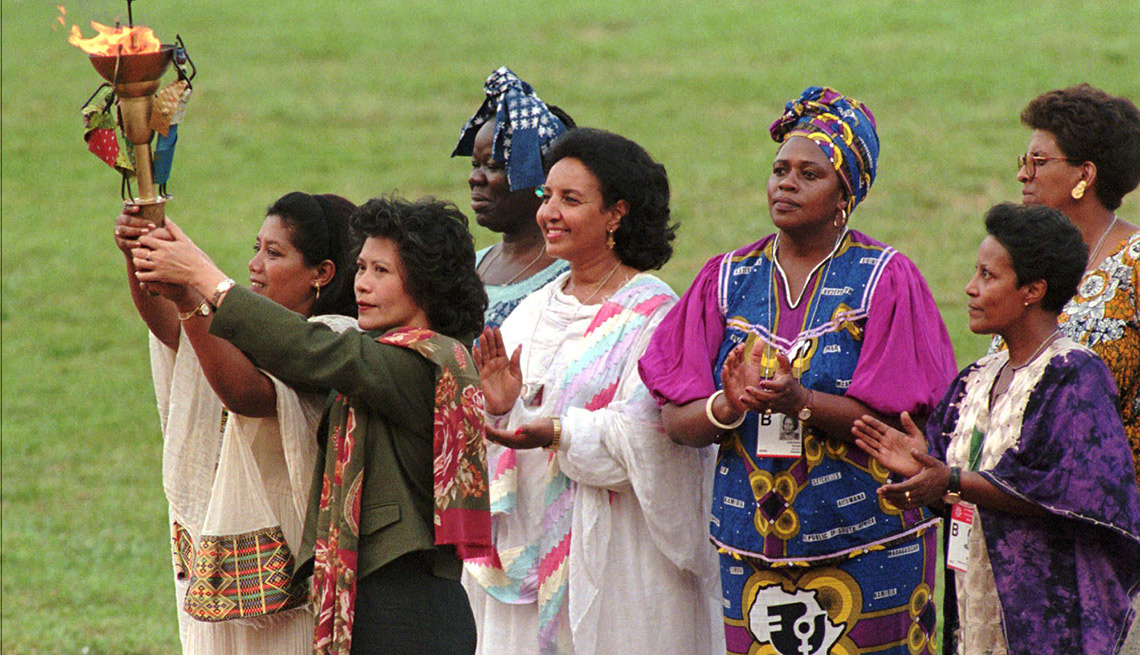
Cast your mind back to 31 years ago—1995 to be exact. Women across the world had assembled in China’s glimmering city called Beijing.
They gathered to deliberate on global issues which affected femininity. They talked. Chanted. Discussed. Declared. Then dispersed into silence.
The stillness that followed the mind-blowing declarations in Beijing was purely because certain corporate bodies and governments that signed those assertions did so with their hands and not with their hearts—they simply followed the multitudes without individual convictions.
However, the silence could not eclipse the thundering statement by the then First Lady of the United States, Hillary Clinton that: “It is no longer acceptable to discuss women’s rights as different from human rights.”
She did not end there. Just before she concluded her less-than-three-minutes-speech, she left the delegates with a talking point: “If there is one message that echoes forth from this Conference, let it be that human rights are women’s rights and women’s rights are human rights, once and for all.”
That statement must have inspired the Abuja Summit of August 21, 2026. The Summit stood out as an idea whose time had actually come.
Though I was not invited, let me briefly play back what happened, the importance it carried, and the weight of decisions arrived at.
No doubt, the Summit—which lasted over six hours—consumed months of meticulous planning.
It was a pool of people that matter in decision-making in Nigeria. Labelled: Inclusion and National Security Summit, it had as its theme: Advancing Women’s Leadership for Inclusive Governance and Security.
From the array of persuasive voices, it did not look like an event whose resolutions would gather dust in government files.
It had ministers, lawmakers, top security agents, judiciary officers, traditional and religious leaders, development partners, civil society groups, women bodies, persons with disabilities, the media, and some diplomatic personnel, in attendance.
The faith I had, as I listened to successive cogent arguments was: If all these people here and those represented, are speaking in favour of the subject matter, then who will delay the implementation of the resolutions when this is over!
I still have that conviction, that issues examined and agreed upon would not be allowed to rot in files. Someone somewhere will somehow look beyond the usual dismissive politics of they have come again, and take action.
Convened by a non-governmental group: I Teach Africa, the Summit sermonised that women’s meaningful participation in governance, peacebuilding, public policy and national security remains essential to building a peaceful, stable, inclusive and resilient Nigeria.
Every speaker agreed that women should not only be viewed as beneficiaries of development and security interventions, but also as active participants, decision-makers, leaders and contributors to national peace and security.
The chief convener, Mrs. Ebimoboere Elezieanya, was emphatic that “a nation is stronger when every voice has a seat at the table.” Here, she was unambiguously referring to the table of decision-making. It was also meant to connote the assembly of those who matter in the society.
Elezieanya, probably a refreshing emerging voice in national dialogue, highlighted important roles women have historically played in peacebuilding, community development, governance, and national security.
With a forceful tone and a convincing spirit, she called for greater opportunities for women—not as a gift, but as a right—to participate, lead and influence decisions that would shape the country.
If it were only women that spoke at the event, it would have been construed as another search for feminine chauvinist endorsement.
Ironically, men—yes, men comprising technocrat, security agents, lawmakers, policy chiefs, and even traditional rulers—were louder in their opinion of what women could do if allowed a space at the metaphoric table.
What no one actually said was whether women need to wait for an invitation or should simply barge in and take a seat at the table. It actually goes without saying that elbowing their way into recognition could be counter-productive.
It would however be recalled that the historic Aba Women Riot of 1929 was not purely about undue taxation imposed by the colonial government.
It also had a lot to do with negligence of the woman gender at the table when ‘dinner’ was served. The women could not wait any longer.
Participants at the Summit collectively recognised that inclusive governance strengthens democratic institutions, promotes peace, enhances social cohesion and contributes significantly to national security.
They emphsised the indispensable role of women as leaders, peacebuilders, innovators and drivers of sustainable development.
It was their view that women’s meaningful participation in these roles not only remain essential to building a peaceful, stable, secure and prosperous Nigeria, but that their economic exclusion, non-access to education, leadership opportunities, and digital technologies have limited their full participation in national development.
Through individual lecture presentations and panel discussions, participants at the Summit which held on August 21 at the Rotunda of the Ministry of Foreign Affairs, observed that Nigerian women are under-represented in governance, political leadership and security decision-making processes.
This in a way has placed a question mark on the execution or the lack of it, of the popular 1995 Beijing Conference which discussed and agreed on certain attentions that must be accorded women by governments and organisations of the participating countries.
They underscored the importance of inclusive governance and women’s meaningful participation in leadership, because national security challenges affect women disproportionately, particularly in communities affected by conflict, violence, displacement and insecurity.
Beyond political ostracism, the Summit noted that economic relegation, poverty and unemployment among women have increased vulnerability and also undermine peace, security and community resilience.
Conversely, education, mentorship and leadership development prepare the female gender for inclusion in governance, public policy and decision-making.
While acknowledging existing policies and legal frameworks on the various issues raised, it was agreed that they require stronger implementation, monitoring and accountability so as to achieve measurable progress in women’s inclusion and representation in governance.
In its simple resolutions, the summit wants government to promote inclusive, transparent, accountable and responsive governance at all levels, and strengthen women’s meaningful participation and representation in political leadership, public administration, governance and decision-making processes.
It also wants government to practically mandate political groups, government agencies and relevant stakeholders to eliminate hurdles and create realistic pathways for augmented women’s participation in leadership—even through mentorship and capacity building
Security agencies were required to strengthen participation by women in peace-building, conflict prevention, security decision-making and community safety initiatives, while emphasizing community-based approaches to early warnings, conflict preventions, and dialogue.
The demand for economic empowerment of women through entrepreneurship development, vocational training, sustainable livelihood opportunities, access to financial literacy, credit facilities, partnerships that create employment, mentorship, innovation and economic opportunities was also made.
Participants observed that in the 21st century Nigeria, certain traditions, communities and families still prevent female children from pursuing education and leadership opportunities. Such a barrier, they observed should be statutorily demolished.
However, most of the demands made by the summit do not seem to require government intervention to function.
For instance, access to digital technologies, digital literacy and digital opportunities for women and strengthening of digital skills are not hindered by any law or social barricades.
The case of online harassment, cyberbullying, and digital violence which could affect or discourage women from participating fully in public and civic spaces are already taken care of by existing laws.
There is no question about the fact that Nigeria has often ignored the implementation of regional and international agreements relating to gender equality, women’s rights, particularly, effective implementation of the principles of United Nations Security Council Resolution 1325 on Women, Peace and Security.
The Summit unequivocally demanded a support policy and legislative reforms that would advance women’s meaningful representation and participation in governance and decision-making, and the need to strengthen the monitoring, evaluation and accountability mechanisms to ensure that policies and commitments produce measurable outcomes.
Strengthening strategic partnerships among government institutions, security agencies, civil society organizations, traditional and religious institutions, the academia, the private sector, development partners and the media also received attention at the summit.
Those who expected that when women gathered to discuss, it would be all noise with little or no direction were disappointed as the conference took off.
This is because the major objectives of the Summit were clearly outlined to guide every speaker and discussant.
From the agenda and direction of discourse, the Summit was called to promote women’s meaningful participation in governance and leadership, examine relationship between women’s inclusion and national security, and promote their participation in peacebuilding and conflict prevention.
Discussions centred on strengthening dialogue between government, civil society, security institutions and communities where conflict always erupt, identify barriers limiting women’s participation in leadership, and foster leadership development opportunities for women.
Therefore, each panel and speaker analysed and suggested ways to strengthen community participation in national security, discuss justice, accountability and public trust, suggest ways of encouraging strategic partnerships for sustainable governance, and propose practical recommendations for strengthening women’s leadership and inclusion.
Whether at the level of individual speakers or panel discussions, a major focus of the Summit was examination of the relationship between women and national security, how insecurity affects women, and why women should have greater opportunities to participate in governance, inclusion and security decision-making.
Every session emphasized the need to recognize women as active contributors to issues of national security rather than viewing them only as helpless victims of insecurity.
As earlier observed, Abuja Summit seemed to have been a re-enactment of the issues, discussions and declarations made in 1995 in Beijing.
That conference which attracted 17, 000 participants comprising groups and individuals, assembled from September 4-15, to talk about women and their negligence by the society.
The Abuja Summit was simply another way of drawing the attention of development and security stakeholders in Nigeria to the fact that issues that dominated the historic Beijing Conference and the declarations made are still pending on the table with little or no attention being given to them.
For avoidance of doubt, the 1995 Conference had centred on the negligence of women and the girl child, the non-involvement of women in education, mentorship, and decision-making on issues of armed conflict, poverty, economic development and human rights.
I can only hope—against hope—that resolutions and declarations made at the I Teach Africa, as captured above, will not go the way of Beijing Conference. Nigerian women deserve attention, not because they are asking for it, but because it is their rights as human beings.














 news1 year ago
 politics1 year ago
 entertainment1 year ago
 entertainment1 year ago
 politics1 year ago
 politics1 year ago
 events2 years ago
 events2 years ago