Connect with us

Opinion

Collapse After a Landslide: Starmer’s Fall May Not be The Last

Published

on

Starmer

By Azu Ishiekwene


Advertisement

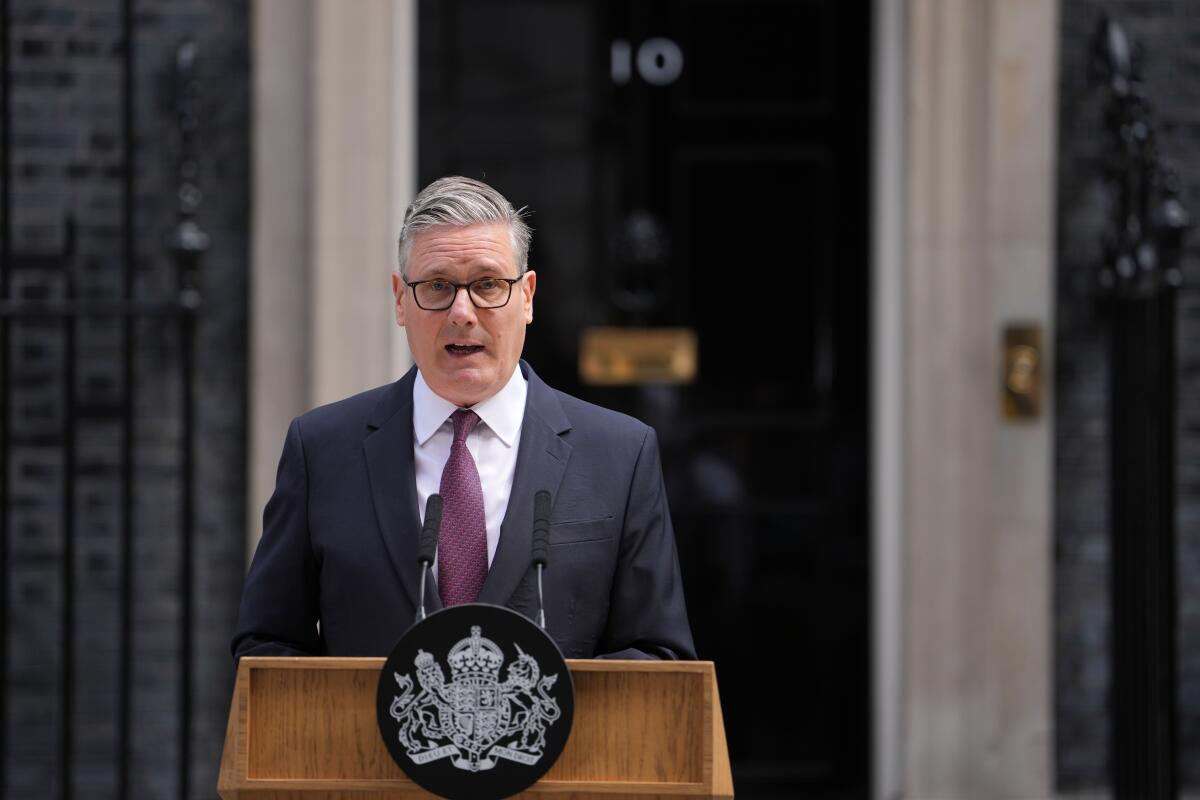
It was painful to watch him outside No.10 on Monday. Despite his immaculate suit and well-groomed hair, British Prime Minister Sir Keir Starmer looked like he was facing a public execution.

Also read: Nigeria’s Adams Joins Venezia on Four-Year Contract

The bespoke podium, which had been in use since David Cameron’s tenure, looked more like a stake, and Starmer’s valedictory like a miserere before the bullets would be discharged.

The carnage that British politics has become has just claimed its sixth prime minister in a decade. Britain is not doing as badly as Italy – yet – which had 50 governments and 15 prime ministers between 1946 and 1994, but at the current rate, it’s not doing badly at becoming Europe’s next Britaly, as The Economist once described it.

Advertisement

Which is all difficult to understand, given that for the two-and-a-half years of his premiership, Starmer never failed to remind voters that he came to power in one of the largest electoral landslides in recent British history.

Not entirely untrue. Labour won 411 of the 650 seats in the House of Commons, a majority of 174 seats over all other parties combined. Starmer’s Labour was the largest party in England, Scotland and Wales, and the first government since 2010 to end 14 years of Conservative rule.

Landslide, backslide

Advertisement

So, what happened? Boris Johnson, who had a chaotic and scandal-ridden premiership, has suggested that Starmer won because the Conservatives collapsed rather than due to voter enthusiasm for Labour.

He told Sky News that Starmer lost because he was a stumbling block who stood in the way instead of providing vision and leadership, virtues that I’m not sure Johnson would recognise, even in plain sight.

He was being half-clear. He conveniently forgot that his wrong-headed decision to remove Britain from the European Union is part of the price his successors, including Starmer, have had to pay. Starmer’s successor, Andy Burnham, will also be paying for it.

Advertisement

A study by researchers affiliated with institutions including the National Bureau of Economic Research and the Bank of England estimated that by 2025, Brexit had reduced UK GDP by between six and eight per cent relative to a non-Brexit scenario.

Business investment was down nearly 18 per cent, while productivity and employment also went down.

Post-Brexit, the British economy has been fragile, and the cost-of-living crisis has taken a toll on the middle class and pensioners. Young British adults are poorer than their parents were.

Advertisement

Complications, complications

Yet, none of this should have come as a surprise to Starmer. He knew that the economy was fragile, that the cost of living was rising, and public services were stretched when he campaigned to provide economic stability, fiscal discipline and a competent government.

When he positioned himself as everything to everyone, that strategic ambivalence helped him to win; it couldn’t keep him in power.

Advertisement

He not only knew the mess that Brexit had left the country in, but he also knew that the country was yet to fully recover from the COVID-19 supply chain disruptions and massive payouts, which added billions of pounds to the national debt, apart from the losses to fraud, estimated by a Reuters report at £10.9 billion.

The US-Israel war on Iran has piled on the chaotic fallouts of the Russia-Ukraine war, raising food prices and energy costs around the world and forcing many UK households to deal with levels of inflation that they had not experienced for years.

Every UK prime minister after Johnson – from Liz Truss to Rishi Sunak and Starmer – has had to contend with the economic legacy of three successive shocks: Brexit, the pandemic, the war in Ukraine, and now, the Middle East crisis.

Advertisement

Politics, poetry and prose

Yet, when politicians campaign, their poetry distorts our common sense, and we’re seduced by the hope that perhaps, just perhaps, it might be different this time.

But Starmer knew there was not much he could do. When he said before the election that Labour would not increase taxes, for example, he knew he would not find the money to plug the hole. So, he was forced to make a U-turn.

Advertisement

When he promised welfare reforms and fiscal discipline, he knew he was speaking with both sides of his mouth. But that was what his voters, especially his base and the campaign groups, wanted to hear.

And when he promised a clean, competent government – a departure from the sleaze years – Peter Mandelson was smiling, waiting to snooker him. The outcome was a shambles for the government’s reputation.

And when Starmer was boasting about a landslide, he knew that the result of the election that brought him to power was more nuanced. It was a victory by default.

Advertisement

While Tony Blair, for example, won 43.2 per cent of the popular vote share in 1997, Starmer won only 33.7 per cent, reflecting a far narrower popular mandate than he cared to admit publicly.

According to a YouGov Poll, among the people who voted Labour in 2024 and then participated in the 2026 local elections, only 46 per cent remained with Labour.

About 22 per cent moved to the Greens, 16 per cent to the Liberal Democrats, while 6 per cent moved to Reform UK.

Advertisement

With a drastic decline in public trust of politicians and public institutions, it’s not surprising that Starmer’s landslide fizzled before he could fully milk it.

The palace coup that forced out the Prime Minister was not because Labour MPs loved him less, but because they love themselves more.

Wheeling in Burnham from the shadows to No.10 was a move by the Backbenchers to buy time and fend off the lunacy of Nigel Farage’s Reform UK Party.

Advertisement

Talking big

Burnham has started by announcing big, obviously more left-wing Labour policies, from removing VAT on domestic electricity bills for six months to restoring the £2 cap on single bus fares across England, and from expanded housebuilding to greater public investment outside London.

He has also talked about increasing defence spending, while whispers of “nationalisation” have even been heard.

Advertisement

But it won’t be long before he might stumble on the question that has snagged his six predecessors: where will the money come from? Once upon a United Kingdom, when the country was at the peak of its powers, it controlled nearly 20 per cent of the world’s manufacturing output, which, of course, was after it robbed India, among others, of its pre-industrial manufacturing dominance and converted it into a primary producing country.

At the height of Britain’s influence, one-quarter of the earth’s surface was its farmland. Those days are gone.

Copying Italy?

Advertisement

The world has changed since Britannia ruled the waves. While Britain remains one of the world’s leading economies, its current sunset phase has taken a heavy toll on its prosperity.

Strong alignment with NATO and the European Community, which later became the EU, helped Italy navigate its turbulent years. Unfortunately, Britain chose to leave the EU when it needed it most.

The last thing the country needs is a premier who sells hope at a high price. Burnham positioned himself as a beacon for his stranded Labour Party.

Advertisement

Also read: Nigeria’s Adams Joins Venezia on Four-Year Contract

Yet his record in Manchester urges caution. Already, he is making expensive, even extravagant promises that may come back to bite him. At this rate, he may well not be the last prime minister before the general election in 2029.

Advertisement
Continue Reading
Advertisement
Click to comment

Leave a Reply

Your email address will not be published. Required fields are marked *

Opinion

Tributes to Dr. Segun Osoba and Abosede Oluwayemisi

Published

on

Dr. Segun Osoba

By Bola BOLAWOLE, 

Dr. Segun Osoba, Marxist scholar and historian, was one of my mentors and role models. Our paths crossed long before I came face-to-face with the enigma at the then University of Ife, now Obafemi Awolowo University, Ile-Ife, where he not only taught me courses in the History department, but was also our staff adviser and comrade.

Advertisement

Also read: Folarin Balogun Linked With Tottenham Move Amid Transfer Talks

Cerebral and unflinchingly principled, Osoba snubbed the usual hussle, if I may call it that, of many academics to attain to the professoral status, preferring to remain “Dr.” even though everyone knew he was not the mate of many a professor!

For me, Osoba’s fame travelled far ahead of him. Appointed by the Murtala Muhammed regime into the Constitution Drafting Committee in October 1975, Osoba, together with his ideological soulmate, Dr. Bala Usman of the History department of the Ahmadu Bello University (ABU), Zaria, broke ranks with the other members of the CDC to author a people-oriented draft Constitution that made the Nigerian people’s interests, aspirations and well-being its focal point. It was termed the Minority Report.

Expectedly, the conservative Olusegun Obasanjo regime that succeeded Murtala Muhammed rejected the Osoba/Bala Usman report while accepting the report of the majority members of the CDC on September 14, 1976. The CDC was chaired by Chief FRA Williams.

Advertisement

The majority/minority report divide apart, the CDC was not without its controversies: The sage, Chief Obafemi Awolowo, had declined to serve on the committee, thereby reducing its members from 50 to 49. There was also the debate as to what would have been the choice of a much more radical Murtala Muhammed had he not been assassinated on February 13, 1976.

Specifically because of Osoba and Bala Usman, I chose to study History in the university! And I was fortunate to drink from the fountain of knowledge at the feet of Dr. Osoba on and off the classroom. As comrades, our relationship did not end at Ife; usually, comradeship is a life-long endeavour.

In late December 2023, after a spell of ‘long-time-no-see’, four of us old students/comrades of Comrade Osoba decided to visit him at his Ijebu-Ode residence – Femi Falana, SAN; Ambassador Ayo Olukanni; Kayode Komolafe (K.K.) and my humble self.

Advertisement

Comrade was still his very sharp and humorous self. Despite his health challenges, he still “recognised” each and everyone of us by our voice. We discussed for hours and it was amazing that ill-health spared his intellect. He was his familiar self – analytical, even if caustic, going down memory lane and recalling facts and figures as if he was reading them from a book spread out before him.

We promised to return. Unfortunately, we procrastinated, despite Olukanni’s repeated prodding. But as individuals, we attended his 90th birthday celebration held at Ijebu-Ode on 9th January, 2025. His book, “Critical and Contentious Issues in the Modern and Contemporary History of Nigeria: Collected Writings of Samuel Olusegun Osoba”, which was unveiled at the occasion, adorns my Library. See also my “Tributes to Comrade (Dr.) Segun Osoba at 90”, published in this column in the Wednesday, 15 January, 2025 edition of the New Telegraph newspaper.

Dr. Osoba passed away peacefully at home in Ijebu-Ode on 14 May, 2026. A flurry of activities by comrades from all the nooks and crannies of this country as well as abroad celebrated his life, extolled his virtues, pledged to continue the struggle from where he stopped, and bid him farewell from this earthly plane. In this were the words of Che Guevara fulfilled: “Wherever death may surprise us, let it be welcome, provided that this, our battle cry, may have reached some receptive ear and another hand may be extended to wield our weapons (Message to the Tricontinental, 1967).”

Advertisement

I was unable to participate fully in some of the activities because of the tragedy that fell at my doorsteps at about the same time.

First, my elder sister’s husband, Gabriel Alani Olusola Omiyale, died on June 11, 2026 at the age of 89 years. He was a mentor. Then came the bombshell: His daughter – and my sister’s second child, Abosede Oluwayemisi – died the same month on June 29th at the age of 54!

That was massive! To say we were devastated is an understatement. If the pains that attended Bose’s death remain indescribable, the ways and manners of her husband and his family immediately before and after her death remain a puzzle. They rubbed insults on our injury.

Advertisement

They desecrated our Yoruba customs and traditions. Bose had heroically battled the scourge of breast cancer; after undergoing an operation, we were all optimistic she was on the path to full recovery until tests showed she needed more medical attention.

Naturally, she was devastated but, gradually, she built up the confidence and strength required to see her through. No stone was left unturned by her extended family who did not leave the load for the husband and his family to carry. All hands were on deck.

The extended family had always been there for Bose. Her siblings had been wonderful; never allowing her husband’s unstable job situation to show or affect Bose’s treatment and other needs, including her children’s education and welfare. I also played my part. I am grateful to everyone who responded to our clarion call in many ways.

Advertisement

We were hopeful we would all pull through it and that Bose’s case would be another testimony that cancer can be beaten. All she needed – as much as medicare – were words of encouragement and support. That, however, became the weakest link!

Act one: Against the best advice of her mother, my niece was made to consume a concoction that turned the tide. According to her husband, the concoction was procured by his own brother in Akure, Ondo state, taken to a church for prayers after which it was dispatched through a motorpark! Bose drank this concoction and started vomiting. In his own testimonies, Bose’s husband took her to a hospital where she was given drips, which gave her some strength, but because the doctor was late in coming, he took her back home despite the fact that the test they ran indicated that she had a blood infection! That night at home, she started vomiting again and, according to the husband’s testimony, he took her again to the hospital by 1.30am. She was left unattended until late afternoon when she fell into a coma! Bose’s blood infection was never treated until she passed away!

Act Two: Our standard practice had been to always double-check whatever a doctor said or prescribed, but on this fatal day, Bose’s husband kept all of us in the dark. We were not told of the blood infection. We were not alerted when she started vomiting again in the night. We were not informed when he took her again to the hospital. According to him, Bose walked with her own legs into the hospital, climbing the row of stairs all by herself.

Advertisement

Act Three: At the hospital, the husband took Bose’s phone and locked it in the car parked downstairs. So she had no access to her phone – to call out or receive in-coming calls. She was held incommunicado. And there was no one else there with the husband and wife. He called noone; he also snubbed repeated incoming calls into his own phone, including from my elder sister, who is Bose’s mother.

Act four: Later that afternoon, the husband called me to say Bose was not responding to treatment and that I should start interceding for her. I was aghast! I had been waiting all day for them to link up with me for a scheduled appointment. Later, a female voice using the husband’s phone called me to quickly come to the hospital. I was on my way there when Bose’s second child, a girl writing exams at the Obafemi Awolowo University, called me, sobbing! “Daddy, what is happening to my Mom? My Daddy called me and said my Mummy is in coma” Coma! “Yes, sir”, the girl replied, “and my Daddy said my Mummy is dead!” I almost lost control of the wheel because I was driving.

Act Five: On getting to the hospital, they had already started embalming Bose! I screamed at the husband, but the hospital staff restrained me. Why the haste? Without any of her family members present! A thousand thoughts ran riot in my head. At 6.28 pm, Bose’s mortal remains were deposited in the morgue and we left.

Advertisement

Act Six: While we were agonizing about how to break the sad news to Bose’s mother, her husband and his family had posted Bose’s death on every conceivable social media platform, breaking the news to her young children, the oldest of whom is just a little over 20 years while the youngest is 14!

Act seven: We the siblings of Bose’s mother wanted a decent burial for her. We wanted her dreams and visions for her children respected. Bose’s husband and his family spurned all of that! They weaponized Bose’s young children against us. They threw their so-called customs and traditions in our face at every turn – as if the Yoruba have no customs and traditions. They employed deceit and subterfuge and hurriedly committed Bose to mother earth without any of her family members present! We warned! They ignored and played games!

Google says Edema is a name answered by both the Urhobo and Itsekiri people of Delta state. Does their culture permit the trumping of Yoruba customs and traditions? Should a husband boast to his children – while their mother was still battling cancer – that, if she dies, he will remarry? So, expect his wedding invitation!

Advertisement

Also read: Folarin Balogun Linked With Tottenham Move Amid Transfer Talks

Had Bose died of cancer, our pains would have been less insufferable; but she did not! Were they tired of the stress and wanted closure so they could move on with their own life? Hastened to her death! Hurried to the grave! This is to put the records straight. Our immediate attention, however, is the good health of Bose’s mother – and Daddy Omiyale’s burial slated for 29th and 30th of October this year.

Let Dr. Segun Osoba rest in power! And eternal rest grant Abosede Oluwayemisi Edema (nee Omiyale), O Lord!


Advertisement

(Published in the TREASURES column on the back page of the Wednesday, 5 August, 2026 edition of the New Telegraph newspaper).

Advertisement
Continue Reading

Trending