The re-elected Osun governor met President Bola Tinubu in Abuja and presented his certificate of return after securing 511,067 votes
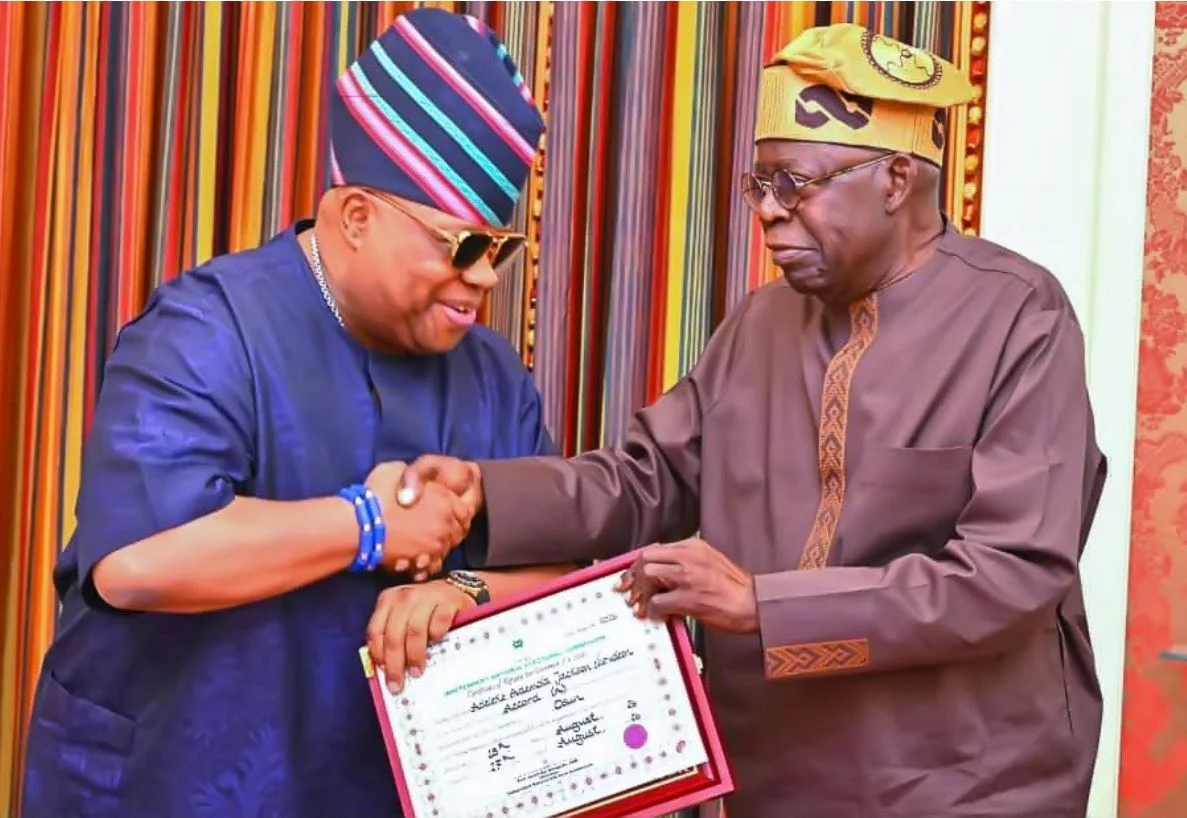
Osun State Governor Ademola Adeleke on Thursday, August 20, 2026, presented his certificate of return to President Bola Ahmed Tinubu during a closed-door meeting at the Presidential Villa in Abuja, in their first face-to-face encounter since Adeleke secured a second term in the Osun governorship election.
Adeleke arrived at Aso Villa shortly after 5:20pm in a navy-blue traditional outfit, carrying a walking stick, and was accompanied by National Security Adviser Nuhu Ribadu. The governor’s visit came four days after the Independent National Electoral Commission declared him the winner of the August 15 poll.
The meeting was notable for its timing, coming just days after a closely watched election in which Adeleke, contesting on the Accord Party platform, defeated All Progressives Congress candidate Bola Oyebamiji by 66,252 votes.
According to the final results announced by INEC, Adeleke secured 511,067 votes, while Oyebamiji polled 444,815. African Democratic Congress candidate Najeem Salaam finished third with 17,180 votes. Adeleke won 19 of Osun’s 30 local government areas, while Oyebamiji won 11.
Photographs from Thursday’s meeting showed Adeleke and Tinubu exchanging handshakes as the governor formally presented the certificate that confirmed his return to office.
Adeleke’s Special Assistant on Digital Media, Olalekan Badmus, confirmed the development in a social media post, saying the governor had presented his certificate of return to the President following the closed-door meeting.
The encounter carried particular political significance because Tinubu’s governing APC had challenged Adeleke’s re-election through Oyebamiji, making the meeting an early indication of the relationship between the federal government and the re-elected governor.
The atmosphere was markedly different from the competitive tone of the election campaign.
Adeleke received his certificate of return from INEC in Osogbo on Wednesday, one day before meeting Tinubu. The certificate was presented by INEC National Commissioner for the South-West, Professor Kunle Ajayi.
The ceremony in Osogbo also provided the governor with an opportunity to reflect on the human cost of the election.
Rather than treating the victory solely as a political celebration, Adeleke announced plans to establish a ₦500 million Election Violence Victims Endowment Fund for verified victims and affected families.
He said the intervention would be humanitarian rather than political and that eligible beneficiaries would not be excluded because of political affiliation, religion, ethnicity, gender or social status.
Adeleke also said the Adeleke family, through the Springtime Development Foundation, would provide full scholarships up to university level for children and dependants of people who lost their lives in election-related violence.
The governor’s response reflected the tension surrounding the election in the weeks before voting.
The campaign period was marked by reports of violence and political clashes, although the election itself produced a decisive result after voting across all 30 local government areas.
INEC’s final figures showed 1,005,800 votes cast, comprising 985,079 valid votes and 20,721 rejected ballots.
Adeleke’s victory also represented a significant political turnaround from the party platform on which he first won the governorship.
In 2022, he contested under the Peoples Democratic Party and defeated former governor Gboyega Oyetola, who is now the Minister of Marine and Blue Economy. Adeleke subsequently moved to the Accord Party before the 2026 election and successfully defended his position.
His latest victory gives him another four-year mandate and places him at the centre of Osun’s political affairs as Nigeria moves towards the 2027 general elections.
The meeting with Tinubu therefore carries significance beyond the presentation of a certificate.
It provides an early opportunity for the federal and state governments to establish a working relationship after an election in which their political interests were directly opposed.
Tinubu had congratulated Adeleke after the result was declared, describing the outcome as a reflection of the choice made by Osun voters. The President’s recognition of the result also helped set a conciliatory tone after the contest.
For Adeleke, the immediate challenge is now to translate electoral victory into governance while addressing divisions that emerged during the campaign.
His pledge to support victims of election violence suggests an attempt to move quickly from political competition towards reconciliation.
The presentation of his certificate to Tinubu at Aso Villa offered a similarly symbolic moment: a victorious opposition-aligned governor meeting the President whose party had sought to unseat him.
With the election behind him, Adeleke has already urged Osun residents to shift their attention from campaigning to governing, healing and development.
The Aso Villa meeting adds another chapter to that transition, bringing together two political figures who stood on opposing sides of the recent contest but now face the practical demands of working within Nigeria’s federal system.




 news1 year ago
 politics1 year ago
 entertainment2 years ago
 entertainment2 years ago
 politics2 years ago
 politics1 year ago
 events2 years ago
 events2 years ago