
news
One Child, Three Nations: The Human Story Behind an International Custody Battle


A complex cross-border custody case involving France, Nigeria and the UK has raised difficult questions about parental rights, court jurisdiction and the welfare of a young child
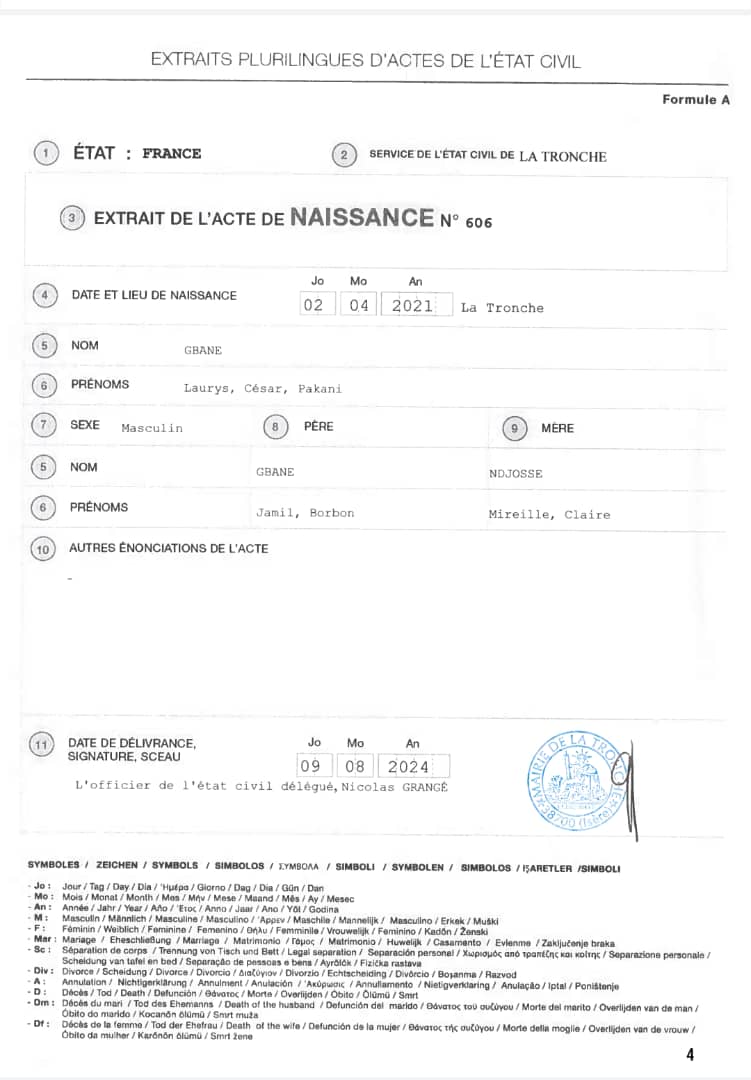
In a profound international custody dispute, British-Nigerian engineer Ifedayo Adeyeye stands resolute in his belief that his five-year-old son, Laurys, is best served by remaining in Nigeria.
Also read: UK-Based Nigerian Remanded in Custody Over Death of Fellow Nigerian
He contrasts this with his mother Claire Mireille N’Djosse’s chaotic life as a refugee in France. This legal battle has illuminated the contrasting worlds of two parents vying for the heart and future of a young boy caught in a whirlwind of competing narratives.
Ms. N’Djosse, a Cameroonian refugee, obtained an order from the English court in respect Laurys.
The court, led by Mr Justice Hayden did not exercise jurisdiction on the basis of habitual residence but invoked the inherent “parens patriae” jurisdiction founded on the child’s nationality.
In doing so it declined to accord comity to a subsisting injunction of the High Court of Lagos which had already adjudicated on the same matter, and made an order irreconcilable with it.
The English authorities require that nationality jurisdiction be exercised with considerable restraint, particularly as a child is habitually resident abroad and proceedings are already before the courts of that jurisdiction.
Those considerations were engaged here: while the court accepted that Laurys had been habitually resident in France immediately prior to his removal in July 2024, as of today’s date he has since been living in Lagos for two years and we’ll integrated into a social and family environment here.
Thus, Adeyeye presents a compelling counter-narrative focused on Laurys’s well-being. In Nigeria, Laurys resides with his paternal uncle and aunt, supported by a robust network of relatives providing a nurturing environment.
Adeyeye asserts that his son enjoys a lifestyle filled with love, attending nursery school, swimming lessons, and community activities. “Laurys is flourishing here,” he states.
Adeyeye argues that Laurys’s current circumstances in Nigeria are vastly more favorable than his previous life in France, where he faced instability and insecurity.
The French foreign ministry has declared both N’Djosse and Laurys as non-citizens, complicating their situation. In contrast, Laurys holds dual British and Nigerian citizenship through his father, providing him with better educational and familial opportunities.
Having raised two daughters into adulthood after his marriage ended, Adeyeye emphasizes his capability to provide for Laurys emotionally and financially. He highlights the stark contrast between his stability and N’Djosse’s reliance on public assistance and refugee support.
Legal experts note that while international custody laws typically prioritize habitual residence, Adeyeye urges the courts to focus on Laurys’s immediate welfare.
He questions the rationale behind enforcing a return to France, where Laurys has no citizenship and where his welfare could be at risk.
Concerns regarding Laurys’s safety and emotional health during his early years in France are critical to Adeyeye’s argument.
He recalls troubling behaviours exhibited by Laurys upon his arrival in Nigeria, including a noticeable fear of women, which he attributes to unstable dynamics in his mother’s care.
Adeyeye fears that a return to such an environment could be detrimental to Laurys’s development.
Despite the contentious atmosphere, Adeyeye remains open to structured contact between Laurys and his mother.
His family has expressed willingness to welcome N’Djosse to Nigeria, offering her the chance to co-parent and build a new life rather than remain in a refugee setting with minimal support.
“We are ready to facilitate a relationship that prioritizes Laurys’s stability and well-being,” the family reiterated.
The complexity of this case underscores the challenges of modern family law, where emotional bonds, citizenship, and cultural ties intertwine. Ongoing legal proceedings across multiple jurisdictions will ultimately determine Laurys’s future.
Yet, as of now, evidence suggests he is thriving in Nigeria where he is well-adjusted and supported by a loving family.
In a world where legal definitions often clash with emotional realities, Adeyeye’s focus remains clear: ensuring that Laurys grows up in an environment rich with family support and stability.
As he navigates the labyrinth of international law, Adeyeye is unwavering in his belief that Laurys’s best interests are best served with his father’s family in Nigeria, far from the uncertainties of life as a refugee.
In Adeyeye’s eyes, Laurys is not merely a pawn in a legal game but a child deserving of love, stability, and a community that celebrates his heritage.
Also read: Sujimoto CEO Allegedly Denied Lawyers, Medical Attention in EFCC Custody
As court proceedings unfold, the hope remains that Laurys will be afforded the opportunity to thrive in a secure and nurturing environment, surrounded by those who truly cherish him.



-

 news12 months ago
Comfort Emmanson Yet to Decide on Legal Action Against Ibom Air
-

 politics12 months ago
Labour Party Protest Slams INEC Over Candidate Exclusion in Bye-Elections
-

 entertainment1 year ago
Ayra Starr teases new collaboration with Wizkid, sending fans into frenzy
-

 entertainment1 year ago
Bolanle Austen-Peters hit stage play, “Dear Kaffy”, returns to Lagos for special Easter showing after international success
-

 politics1 year ago
Court rules in favour of Isale-Eko community on intellectual property rights over “Gangs of Lagos” film
-

 politics1 year ago
Ekiti Governor Politicise Elemure Stool in Shocking Traditional Betrayal
-

 events1 year ago
Anietie Udoh joins AME awards 2025 Grand Jury, elevating Nigeria’s IMC presence
-

 events1 year ago
Nigerian-American Chamber of Commerce to inaugurate 20th president, executive council, unveils bold economic agenda