Education Minister Tunji Alausa says a nationwide household survey with the National Bureau of Statistics will replace outdated estimates and shape targeted interventions for millions of Nigerian children
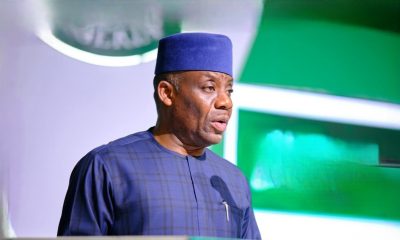
Minister of Education Dr Tunji Alausa has unveiled plans for a nationwide Out-of-School Children Survey, describing the exercise as a decisive step towards replacing long-standing estimates with reliable data that can reshape education policy and help Nigeria tackle one of the world’s biggest learning crises.
Speaking at the 2026 Annual Education Summit organised by the Education Correspondents Association of Nigeria in Abuja on Wednesday, Alausa said the Federal Ministry of Education would work with the National Bureau of Statistics to conduct a comprehensive household survey capable of revealing the true scale and distribution of children outside the formal school system.
The announcement marks a significant shift in the government’s approach to one of Nigeria’s most persistent development challenges. For years, policymakers, development partners and education advocates have relied on varying estimates, with figures generally ranging from 15 million to about 20 million out-of-school children.
International agencies have also consistently ranked Nigeria among the countries with the largest number of children excluded from education, although methodologies and age brackets differ. (UNESCO)
Alausa acknowledged that the commonly quoted figures no longer reflected the current reality and said credible statistics were essential for designing effective interventions.
“The nationwide household survey will provide a clearer picture of the magnitude and distribution of the challenge, enabling the government to design more targeted interventions to improve access to education,” the minister said.
The initiative comes as the Federal Government seeks to anchor education reforms on measurable evidence rather than assumptions, reflecting a broader push towards data-driven governance across public institutions.
Alausa said more than one million out-of-school children had returned to classrooms over the past two years, but stressed that measuring genuine progress required accurate baseline data.
“Existing estimates require updating. We are committed to replacing assumptions with credible, evidence-based statistics,” the minister said.
The planned survey is expected to provide policymakers with a detailed picture of where children remain outside the education system, the reasons behind their exclusion and the communities requiring urgent intervention.
Education specialists have long argued that inconsistent data has complicated efforts to direct resources efficiently.
While insecurity continues to disrupt learning in parts of the North East and North West, poverty, child labour, early marriage, displacement, inadequate school infrastructure and cultural barriers remain major drivers of school exclusion across several regions. UNICEF estimates that Nigeria accounts for one in every five out-of-school children globally, underlining the scale of the challenge. (UNICEF)
Beyond announcing the survey, Alausa urged journalists to play a stronger accountability role by relying on verified data rather than assumptions.
According to the minister, investigative reporting should complement official policy by exposing gaps in education delivery and tracking government performance through measurable evidence.
He argued that credible journalism could strengthen public confidence while encouraging more effective implementation of education reforms.
The minister also highlighted ongoing initiatives under President Bola Tinubu’s Renewed Hope Agenda, including expanded Technical and Vocational Education and Training, greater investment in Science, Technology, Engineering and Mathematics education, digital transformation, quality assurance and governance reforms.
Another notable moment during the summit was Alausa’s disclosure that Nigeria had experienced three consecutive years without disruptions to academic activities in universities, polytechnics and colleges of education, an achievement he attributed to sustained dialogue with tertiary institution unions.
He also revealed that 24 Nigerian universities are now ranked among the world’s top 1,000 institutions, compared with 21 previously, with public universities occupying the country’s four highest positions.
Minister of State for Education Prof Suwaiba Ahmad reinforced the call for responsible reporting, describing education as central to national development.
“Education is the foundation upon which we build a productive economy, strengthen democratic institutions, reduce poverty and promote social cohesion,” Ahmad said.
Executive Secretary of the Universal Basic Education Commission Dr Aisha Garba echoed that message, insisting that access to quality basic education must remain universal.
“The most important objective is that no child should be left behind. Regardless of background, location or income level, every child must have access to quality education,” Garba said.
The summit, themed Three Years of the Tinubu Administration: Assessing Reforms, Progress and Challenges in Nigeria’s Education Sector, brought together policymakers, education stakeholders and journalists to review achievements, identify remaining gaps and discuss the future direction of the country’s education system.
The proposed Out-of-School Children Survey is expected to become one of the government’s most important education data exercises in years.
Beyond updating national statistics, officials hope it will provide the evidence needed to target investments more effectively, strengthen school enrolment strategies and improve collaboration with states, development partners and local communities.
For millions of Nigerian children still waiting for a place in the classroom, the success of the exercise may ultimately be judged not by the numbers it produces, but by whether those figures translate into classrooms built, teachers deployed and opportunities restored.








 news11 months ago
 politics11 months ago
 entertainment1 year ago
 entertainment1 year ago
 politics1 year ago
 politics12 months ago
 events1 year ago
 events1 year ago