Bola BOLAWOLE
Joash Amupitan nominated INEC chairman by President Tinubu, becoming the first Kogi native in the role and hailed for integrity and apolitical standing
“You don win! You don win! You don win!”
“What is the meaning of that? What did I win? Me that I don’t play lottery or Bet Niger or Baba Ijebu!”
“What you won is more than all those combined! Whoever has INEC has everything in the Nigeria of our dispensation”
“I still don’t understand the reason for this hysteria of yours”
“Why wouldn’t you? Were you not the one who commanded President Bola Ahmed Tinubu to choose the next INEC chairman from Yoruba land? And has he not obeyed you?“
“Oh, I see! I did not command; I only said the obvious. A Yoruba person has never been the INEC chairman. Why? What crime did the Yoruba commit to be so marginalized?“
“We are still saying the same thing. What if Mr. President had ignored your so-called sound argument to do the contrary? Would you have arrested him?”
“Not really; but he would have lost an opportunity to redress a long-standing injustice against his own people. No one can grudge him for nominating a Yoruba person as the next INEC chairman if the nomination sails through…”
“Forget about sailing through! It has sailed through already…”
“Don’t let us always talk like that! The president only nominates. It is the duty of the Senate to confirm or reject…”
“But has that ever happened?”
“That it has never happened does not mean it can never happen. There is always a first time, as they say. But whose fault is it if the senators choose to do their job one way or the other? Once the president nominates, the ball rolls to the court of the Senate. They are free to play it as they like”
“I beg to disagree! They must play it according to the rules. They are to screen – and screen they must!”
“I agree with you in that. Had they screened properly, we would have been saved the series of embarrassments that have hallmarked this Fourth Republic, beginning with Salisu Buhari, the first Speaker of the House of Representatives; then Kemi Adeosun and now the Minister of Innovation, Science and Technology, who was forced to resign last week”
“I like the innovation of the disgraced Minister of Innovation. You cannot be made the minister of innovation and be unable to innovate!”
“What do you mean?“
“Is it not an innovation that the erstwhile minister served his mandatory NYSC before graduating from the university?“
“I see! It turned out he never graduated and he never served…”
“You see what I mean? That is double innovation! He never graduated; he never served; yet he scaled through screening at the presidency, then with the security agencies and, finally, at the Senate…”
“We must salute the media that found him out…”
“Some people who had his records must have squealed on him. He must have stepped on toes…”
“That is true! There is no criminal that is not known by one person or another. There must be many of his type still hiding in various sectors of our national life…”
“Let’s leave that alone and let’s return to INEC. Controversy continues to trail Tinubu’s choice. They said he was a card-carrying APC member…”
“In fact, they said he was a member of the legal team that defended Tinubu’s 2023 election victory at the tribunal, but …”
”I was alarmed when I first heard that! Could they have been so stupid, both to nominate and to accept, until I saw that it was a case of mistaken identity”
“Mistaken what?“
“Mistaken identity! Osipitan is different from Amupitan. Otherwise, Obi and Atiku would have since hit the roof with their head”
“Yoruba people sef! They specialize in twisting words and tongues! Osi-pitan! Amu-pitan! Pitan, Pitan all over the place! What is the difference between the names?“
“Honestly, I don’t know! But ‘to Pitan’ means to tell a story. Maybe the names tell a story. Or the circumstances of birth or the time of birth…”
“I think ‘osi’ in Yoruba means poverty…”
“Yes, but the pronunciation of this particular ‘osi’ in Pitan is not the same as you pronounce poverty. It is pronounced differently…”
“I see! A name that tells stories signifies that the man’s tenure will tell stories…”
”That is, if it is not already doing so! One BAT nominates another BAT for a position as important as that of the INEC chairman“
“What do you mean? Who is BAT 1? And who is the other BAT?”
“Don’t you know that the initials of President Bola Ahmed Tinubu translates into BAT?”
“I see! But Amupitan’s do not! He is Joash Ojo Amupitan aka JOA”
“He is a BAT in another dimension. He comes from a section of the country which is neither South nor North. Or better still, which is both North and South, depending”
“I don’t understand”
“Amupitan is a Yoruba name. The man himself, ethnically-speaking, is Yoruba but his geo-political zone, North-Central, is part of the North”
”I see! He is at once a southerner as well as a northerner! That is double blessing…”
”Under Tinubu, it has apparently been double blessing for the Yoruba elements in the north-central zone. A case in point is Ojulari, the NNPC boss; now Amupitan, but it has not always been so”
“How do you mean?“
“In times past, the North merely used them to make up the numbers but marginalizes them when it comes to sharing the largesse that flows therefrom”
“Quite unfortunate! When they are needed; they are embraced and given the fake impression that they belong to the North, but after they have been used, they are dumped! Is that not what you are trying to say? “
“Exactly! Now that Tinubu is trying to redress this age-long injustice, some people are running their mouths”
’That is to be expected! Politics can be read into anything! But do you think the man will live up to expectations?”
“Whose expectations is the question! ”
“The people’s, of course!”
“Is it the people that nominated him? Or is it the people that will confirm his nomination? Abeg, leave the people out of it jare!”
“As INEC chairman, he is expected to conduct free and fair elections. He must ensure that elections conducted under his watch are credible…”
“Are you aware that INEC chairman alone cannot guarantee credible elections? Where do you place the politicians, the security agencies, and the voters themselves? What of INEC’s permanent and ad-hoc staff? And where do you place the government in power?’
“That is true! This is a classical case of what the economists call ceteris paribus, meaning all other things being equal, but can all other things ever be equal? “
“That is the issue, but I am surprised that Tinubu chose the person he nominated. I thought he would push it in our nose and nominate his son, Seyi, or the audacious Iyaloja, as the next INEC chairman!”
“God forbid!”
“God forbid wetin? If he did, will the heaven fall? The man is audacious enough to do anything! After the removal of fuel subsidy and forex exchange equalization, all in one fell swoop, I don’t think there is anything this man cannot do again”
“That’s true! Have you heard the news? Another PDP governor has defected to APC…”
“Stale news! We knew all along that Enugu would fall. The next is Bayelsa…”
“But I smell a rat! Can it be that the opposition people are emptying themselves into the ruling party so they can fight it from within and capture power through the back door?”
“Something like what Mikhail Gorbachev did in the USSR? He waltzed his way to the top echelon of the Communist party and thereafter unleashed his glasnost and perestroika bombshells that scattered the communist behemoth“
“My fear is: Will it be easy for the PDP to pull such sucker punch against Tinubu here? The man is a master strategist…”
“But when someone gets too wise and crafty, he may get ensnared in the process. Witness how IBB aka Maradona dribbled himself into a corner. He stepped aside never to step in again…”
“Between me and you, I never expected Tinubu to nominate a man as clean as Amupitan is said to be as INEC chairman. Has he learnt anything from the mistakes of Jonathan or is he repeating them?”
“You think Amupitan can jaga-jaga him as was done to Jonathan?“
“I have my fears! The Yoruba people are too finicky about integrity and doing the right thing…”
“Then, where do we place the whole argument? The Yoruba deserve the post; yet…”
“Just take note that it is one of the wonders of our world that a sitting president can open his eyes and nominate a man many are saying has integrity. IBB made the same mistake with Humphrey Nwosu…”
“Maybe Tinubu is sure of his onions! With the opposition parties in disarray and the politicians that matter emptying themselves into APC, what else is there for Tinubu to fear?”
“Politics is not that straightforward. By the way, we intimated our readers two weeks ago about the mathematical wonder of 2520…”
“Yes, that is true. The number looks like any other number but there is something strange about it. It is divisible by any number from 1 to 10…”
“How does that correlate with happenings in the polity?“
“Simple: Not everything that appears normal on the surface is actually or in the final analysis normal”
“That is deep!”







 news12 months ago
 politics12 months ago
 entertainment1 year ago
 entertainment1 year ago
 politics1 year ago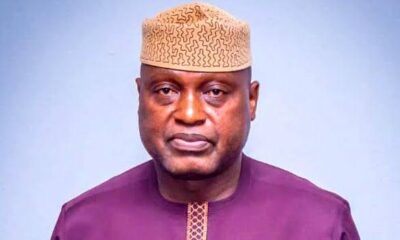
 politics1 year ago
 events1 year ago
 events1 year ago